Home ← Back

Blog

  • Free VIN Check vs CARFAX: What’s the Difference? (2026 Guide)

    Free VIN Check vs CARFAX: What’s the Difference? (2026 Guide)

    Free VIN Check vs CARFAX: What’s the Difference?

    Free VIN Check vs CARFAX Explained

    If you’re shopping for a used vehicle, you’ve probably searched for a free VIN check before deciding whether to purchase a vehicle history report. Understanding the difference between a Free VIN Check vs CARFAX report can help you save money while still learning valuable information about a vehicle before making a purchase.

    A Vehicle Identification Number (VIN) acts as a unique fingerprint for every vehicle on the road. By entering a VIN into a decoder tool, buyers can learn important information about a vehicle’s specifications, manufacturer details, safety features, recalls, and more.

    Before spending money on a premium history report, many buyers start with a free VIN lookup to verify that the vehicle matches the seller’s description. This simple step can help identify inconsistencies and provide additional confidence during the buying process.

    At VinForFree, drivers can run a free VIN lookup to access detailed vehicle specifications and safety information directly from publicly available sources.

    What Is a VIN Number?

    A VIN is a 17-character code assigned to every vehicle manufactured after 1981. Each character contains information about the vehicle’s manufacturer, body style, engine type, model year, and assembly plant.

    For example, a VIN can reveal:

    • Vehicle year
    • Make and model
    • Engine specifications
    • Body style
    • Transmission information
    • Manufacturing plant
    • Country of origin

    Understanding how a VIN works helps buyers confirm that a vehicle matches its advertised specifications before completing a purchase.

    What Information Does a Free VIN Check Provide?

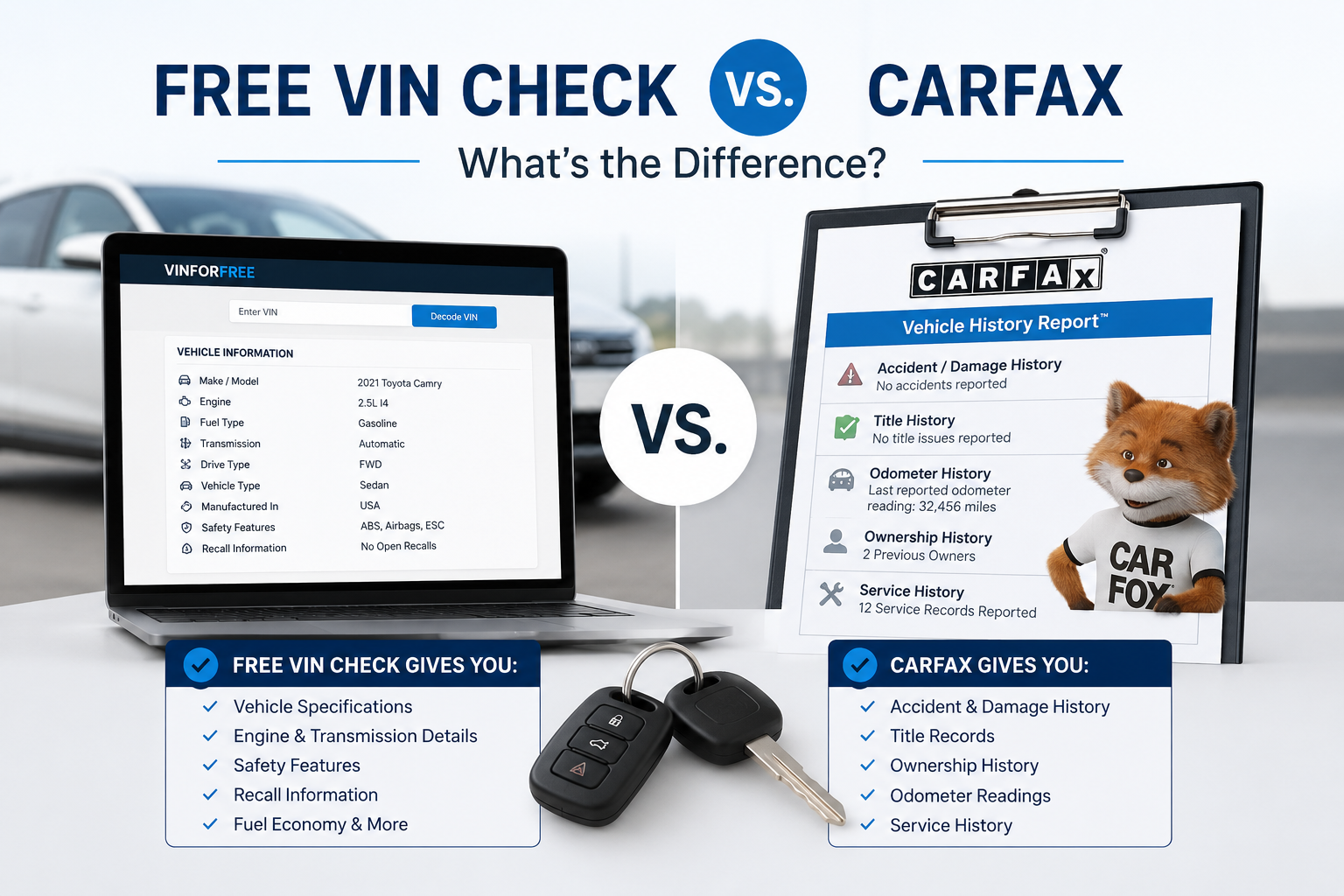
    When comparing Free VIN Check vs CARFAX, it’s important to understand what a free VIN report can provide.

    A quality VIN decoder may include:

    • Vehicle specifications
    • Engine details
    • Fuel type
    • Drive type
    • Safety equipment
    • Manufacturer information
    • Fuel economy ratings
    • Recall information
    • Crash test data
    • Production details

    This information can help verify the identity of a vehicle and ensure that important specifications match the seller’s claims.

    Many buyers are surprised by how much information can be obtained through a free VIN lookup before purchasing a premium report. You can view a sample report for a Ford Explorer VIN here.

    What Information Does CARFAX Provide?

    CARFAX focuses primarily on vehicle history records rather than vehicle specifications.

    A typical CARFAX report may include:

    • Reported accidents
    • Title records
    • Odometer history
    • Ownership history
    • Registration records
    • Service records
    • Damage reports

    Because CARFAX gathers information from thousands of reporting sources, its reports may provide historical events that are not available through a standard VIN decoder.

    This is why many consumers use both tools together. They first perform a free VIN check and then decide whether a paid history report is necessary.

    Why Vehicle Recalls Matter

    One major benefit of running a VIN check is identifying potential vehicle recalls.

    Vehicle recalls occur when manufacturers discover safety-related defects that could affect drivers, passengers, or other road users.

    The official recall database is maintained by the National Highway Traffic Safety Administration.

    For official recall information, visit:

    https://www.nhtsa.gov/recalls

    Checking recalls before purchasing a used vehicle can help buyers avoid costly repairs and identify open safety campaigns that may still qualify for free manufacturer repairs.

    Benefits of Running a VIN Check Before Buying

    Whether you’re buying from a dealership or a private seller, a VIN check offers several advantages.

    Verify Vehicle Identity

    A VIN check confirms the vehicle’s year, make, model, and trim.

    Confirm Engine Specifications

    Many vehicles offer multiple engine options. A VIN decoder helps verify the exact engine installed by the manufacturer.

    Review Safety Features

    Buyers can learn about available airbags, driver assistance systems, crash protection technologies, and other important safety equipment.

    Check Fuel Economy

    Fuel economy data can help estimate long-term ownership costs and compare vehicles before purchasing.

    Research Vehicle Recalls

    Open recalls can be identified before the transaction is completed.

    Free VIN Check vs CARFAX: Which One Should You Use?

    The answer depends on what information you need.

    If you want to verify vehicle specifications, engine details, recalls, safety information, and manufacturer data, a free VIN check is often the best place to start.

    If you need ownership history, accident records, title events, or maintenance history, a CARFAX report may provide additional information.

    Many experienced car buyers use both resources during the research process.

    Final Thoughts

    When comparing Free VIN Check vs CARFAX, the best approach is to use each tool for its strengths. A free VIN lookup provides valuable information about a vehicle’s identity, specifications, recalls, and safety features, while CARFAX focuses on historical ownership and accident records.

    Before buying your next vehicle, start with a free VIN search and verify the details for yourself. Taking a few minutes to research a VIN can help you make a more informed purchasing decision and potentially avoid expensive surprises down the road.

  • Is It Safe to Buy a Car Without Checking the VIN?

    Is It Safe to Buy a Car Without Checking the VIN?

    A VIN Check

    Checking the VIN to Prevent VIN Cloning
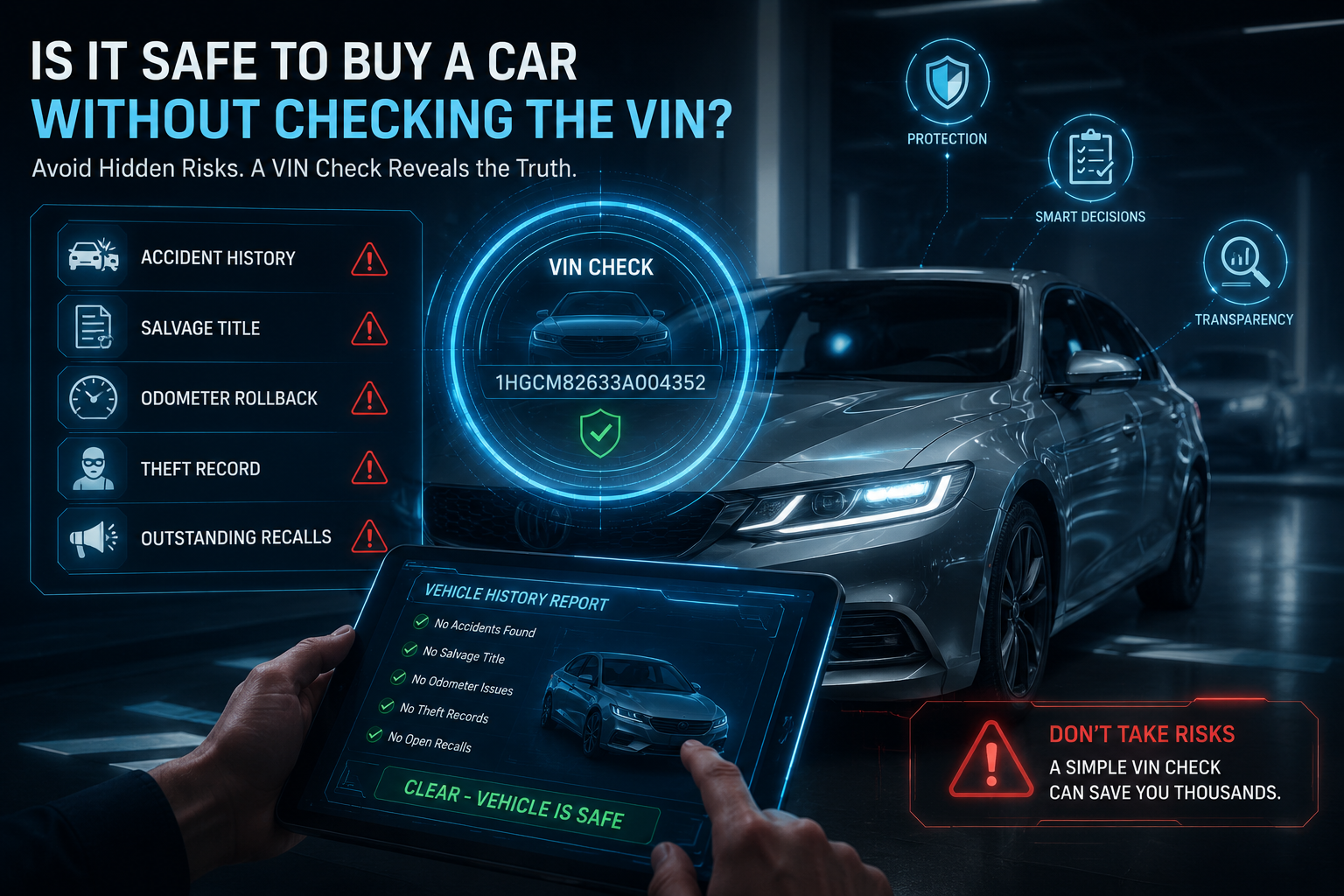
    One of the most sophisticated risks of skipping a VIN check is falling victim to VIN cloning. This happens when a criminal takes a valid VIN from a legally registered car (often from a dealership lot or a scrap yard) and attaches it to a stolen or salvaged vehicle of the same make and model. Without running a digital history report, the car might look perfectly legal on the outside, but you could end up purchasing a stolen vehicle that the police will eventually impound, leaving you with no car and no money.

    What a Visual Inspection Misses vs. Checking the VIN
    Even the most experienced mechanic can’t see a “Lien” or a “Salvage Brand” just by looking at the engine. A physical inspection tells you the car’s current condition, but the VIN tells you its legal status. For example:

    Flood Damage: Cars from hurricane zones are often dried out and sold in other states. The electronics may fail months later, but the “Flood” brand stays on the VIN forever.

    Odometer Rollbacks: Scammers can electronically roll back a digital dashboard. The only way to catch this is to compare the current mileage with the “last reported mileage” found in the VIN history.

    Important Locations for Checking the VIN for Checking the VIN History

    To ensure the VIN hasn’t been tampered with, you should verify it in at least three locations on the vehicle. If they don’t match, walk away from the deal immediately:

    The Dashboard: Visible through the driver’s side bottom corner of the windshield.

    The Door Pillar: Look for a sticker on the driver’s side door frame near where the door latches.

    The Engine Block: Many manufacturers stamp the VIN directly onto the front of the engine or the frame.

    The Hidden Costs of an Unknown History
    When you buy a car without checking the VIN, you aren’t just risking the car’s reliability; you are risking your financial future. If a car has an “unpaid lien” (meaning the previous owner still owes a bank money), the bank can legally repossess the car from YOU—even if you paid the seller in full. A VIN check is the only way to verify that a title is “clear” and ready for transfer.

    Your Pre-Purchase VIN Checklist
    Before you hand over any cash, follow this protocol to protect yourself:
    * **The “Window vs. Door” Test:** Does the VIN on the dashboard match the one on the door sticker? If not, the car may have been rebuilt from two different vehicles (a practice known as “clipping”).
    * **Recall Verification:** Many sellers hide open safety recalls. Use a free tool to see if the car has dangerous defects like exploding airbags or fire risks that haven’t been fixed.
    * **Service Record Gaps:** Look for long periods of time where the car wasn’t registered or serviced. This often indicates the car was sitting in a repair shop or salvage yard.

    Frequently Asked Questions About VIN Checks

    Can I check a VIN for free?
    Yes, platforms like VinForFree allow you to decode 17-digit identification numbers to verify factory specifications and safety recalls without a subscription.

    Does a VIN check show every accident?
    No. While many accidents are reported via insurance or police records, private repairs may not appear. This is why checking the VIN should always be paired with a physical inspection.

    What should I do if the VINs don’t match?
    If the VIN on the dashboard is different from the door pillar or the title, the vehicle has likely been tampered with or “clipped.” You should avoid the purchase immediately.

    How to Spot a “Red Flag” VIN

    When you are checking the VIN, you aren’t just looking for a clean report; you are looking for consistency. Professional scammers have become experts at “VIN Switching,” where they take a VIN from a totaled vehicle and physically move the plate to a stolen car.

    To protect yourself, always look for these three physical signs during your inspection:

    • Scratched Rivets: The VIN plate on the dashboard is held down by special circular or flower-shaped rivets. If these look scratched, bent, or replaced with standard screws, someone has likely tampered with the plate.

    • Mismatched Labels: Manufacturers place “Anti-Theft” labels on various body panels (fenders, hood, trunk). Checking the VIN digits on these stickers against the dashboard VIN is the fastest way to see if the car was rebuilt using parts from different vehicles.

    • The “Check Digit” Validation: The 9th character of every 17-digit VIN is a “Check Digit.” This is a mathematical security feature used by the Department of Transportation to verify the VIN is real. If an online decoder tells you the VIN is “Invalid,” it is a guaranteed sign of a counterfeit vehicle.

  • What Does Each Digit in a VIN Mean? (Full Breakdown)

    What Does Each Digit in a VIN Mean? (Full Breakdown)

    What does a VIN mean? A VIN (Vehicle Identification Number) is more than just a random string of characters

    What Is a VIN Number?

    The VIN is a unique code assigned to every vehicle. It includes letters and numbers that identify the manufacturer, model, engine type, and production details.

    Table of Contents

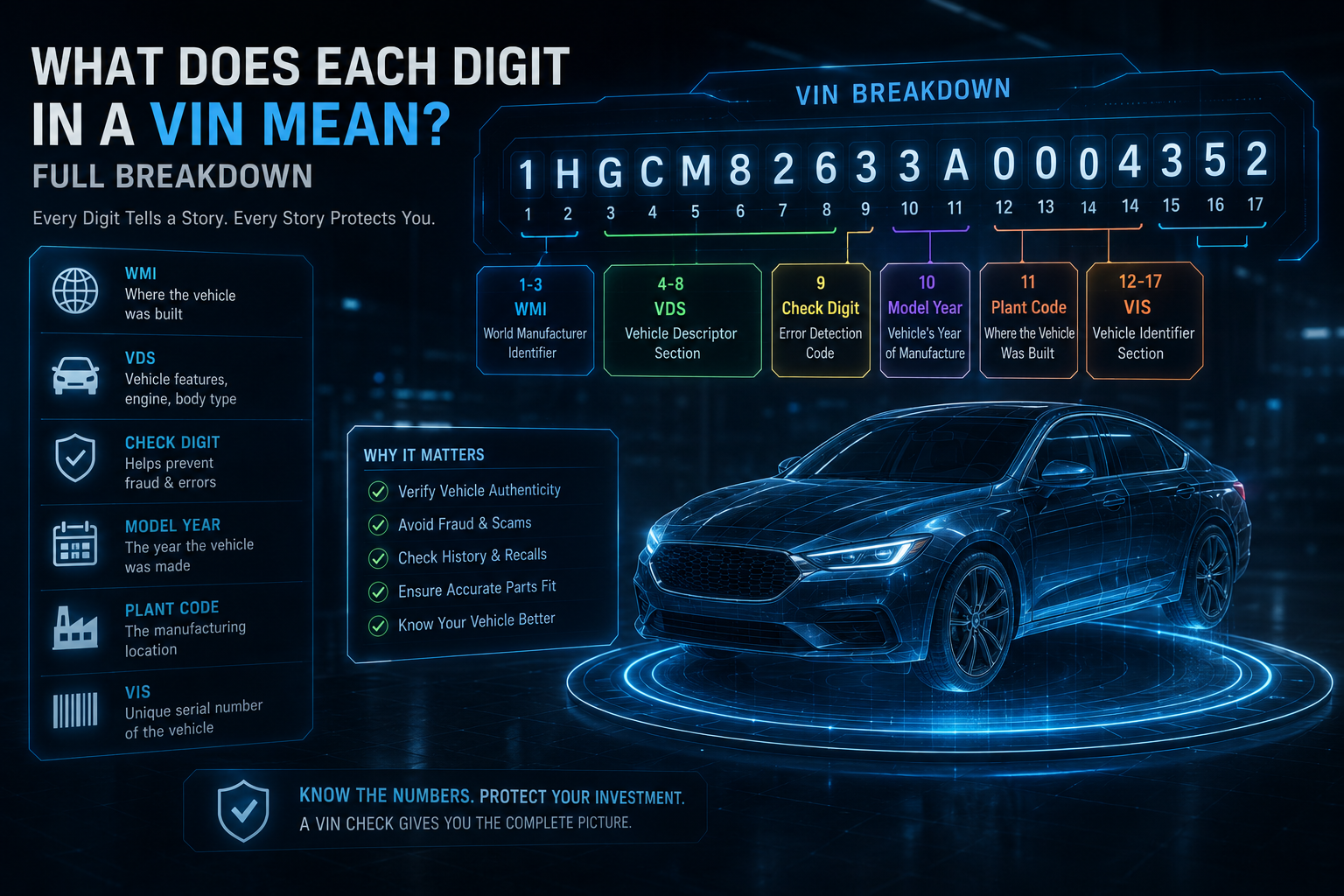
    The 17 characters in a VIN are divided into sections:

    • Characters 1–3: Manufacturer and country of origin
    • Characters 4–8: Vehicle attributes (model, engine, body type)
    • Character 9: Check digit (used for validation)
    • Character 10: Model year
    • Character 11: Assembly plant
    • Characters 12–17: Production sequence number

    It is also important to note that VINs do not include the letters I, O, or Q. This is a global standard used to avoid confusion with the numbers 1 and 0. If you ever see these letters in a serial number while checking what a VIN means, it is a guaranteed sign that the VIN is counterfeit or incorrectly transcribed.

    Why Understanding a VIN Matters

    Knowing how to read a VIN helps you verify that a vehicle matches its listing. It can also help detect fraud or incorrect information.

    Use a VIN Lookup Tool

    If you don’t want to decode the VIN manually, you can use a VIN lookup tool to instantly view all details.

    Check out VinForFree to run a free Vin check.

    Breaking Down the Sections: What Does a VIN Mean

    To truly understand what does a VIN mean, you have to look at the three distinct groups that make up the 17-character string.

    The WMI (World Manufacturer Identifier) The first three digits tell you who built the car and where. For example, if the first digit is a 1, 4, or 5, the vehicle was assembled in the United States. A ‘J’ stands for Japan, and a ‘W’ stands for Germany.

    The VDS (Vehicle Descriptor Section) Digits 4 through 9 are the “DNA” of the car. This section describes the model type, the body style, and the engine specs. Digit 9 is particularly interesting—it is a “Check Digit” used to verify that the VIN is authentic and not a fake generated by a scammer.

    The VIS (Vehicle Identifier Section) The final 8 digits are unique to your specific vehicle. Digit 10 is the most popular one for buyers to check because it represents the Model Year. Digit 11 tells you the specific assembly plant where the car was put together, and the final 6 digits are the sequential production number.

    How to Use This Information When Buying

    When you are looking at a used car, what does a VIN mean for your wallet? It means protection. If the VIN on the dashboard doesn’t match the VIN on the door sticker or the title, you are looking at a “cloned” car or a vehicle that has been rebuilt from scraps. Always verify these digits match across all locations before handing over any cash.


    Advanced Decoding: How Pros Use the 10th and 11th Digits

    If you are still wondering what does a VIN mean for specific model verification, you need to look closely at the “Plant and Year” section. While most people can guess a car’s age by its body style, the 10th digit provides the legal model year.

    For example, a “Y” in the 10th position signifies the year 2000, while letters like “A” through “H” represent 2010 through 2017. This is critical because some manufacturers release “New Generation” models mid-year. By checking what a VIN means at the 10th digit, you can ensure you aren’t paying a premium for a 2024 model when the car is actually a late-release 2023.

    The 11th digit is equally important. This represents the Assembly Plant. If you are buying a vehicle known for having build-quality issues at a specific factory, the 11th digit will tell you exactly where that frame was welded and the engine was dropped in.

    The Math Behind the 9th Digit: The “Check Digit”

    One of the most fascinating answers to “what does a VIN mean” lies in the 9th character, known as the Check Digit. This digit is the result of a complex mathematical formula involving all the other characters in the VIN.

    Each letter is assigned a numerical value, multiplied by a “weight” factor, and then divided by 11. The remainder of this math problem becomes the 9th digit. This exists specifically to stop criminals from inventing fake VINs. If a scammer changes even one number to hide a car’s history, the “Check Digit” math will fail, and a professional VIN lookup tool will immediately flag the serial number as invalid. This mathematical validation is a security standard monitored by the National Highway Traffic Safety Administration (NHTSA) to prevent vehicle identification fraud. You can also verify technical WMI codes through the Society of Automotive Engineers (SAE).

    Summary Checklist for VIN Decoding

    To ensure you have a complete grasp of what does a VIN mean during a live inspection, use this quick reference:

    • Characters 1-3: Does the country of origin match the “Made in…” sticker on the door jamb?

    • Character 10: Does the model year match the paperwork provided by the seller?

    • Character 17: Does the final serial number match the etched number on the engine block (if visible)?

    By taking these extra steps, you transition from a casual buyer to an informed expert, ensuring that the vehicle you are putting your family in is exactly what the manufacturer intended it to be.

    Final Thoughts

    Understanding what each VIN digit means can give you valuable insight into a vehicle. Whether you decode it yourself or use a tool, it’s an important step in verifying any car.


    If you want to skip the manual decoding to understand what does a VIN mean for your specific car, you can check a VIN for free using our automated lookup tool.

  • Top 5 Mistakes When Buying a Used Car (And How to Avoid Them)

    Top 5 Mistakes When Buying a Used Car (And How to Avoid Them)

    Buying a used car can save you thousands of dollars, but many buyers make costly mistakes that could have been avoided. Knowing what to watch out for is the key to a successful purchase. Here is how to navigate the process of buying a used car like a pro.

    1. Skipping the Professional VIN Check

    One of the most catastrophic mistakes is not checking the vehicle’s history. A VIN (Vehicle Identification Number) is the car’s DNA. Skipping a free VIN check means you might miss active recalls, title brands (like salvage or flood damage), and odometer discrepancies. Always verify the history before handing over any cash.

    2. Not Inspecting the Vehicle in Person

    Even if a car looks pristine in high-resolution photos, hidden issues like frame damage or engine sludge may exist. Always inspect the vehicle in broad daylight. If you aren’t mechanically inclined, consider a Pre-Purchase Inspection (PPI). You can find reliable local inspectors through platforms like Lemon Squad.

    3. Ignoring the Title Status

    A “Clean Title” is essential for long-term value. Many buyers fall for “Rebuilt” or “Salvage” titles because the price is lower. While these cars are cheaper up-front, they are harder to insure and have significantly lower resale value. Always verify the physical title against the VIN on the dashboard to ensure they match.

    4. Falling for Deals That Seem “Too Good to Be True”

    Scammers often list high-demand vehicles at 30-50% below market value to lure in hurried buyers. According to Consumer Reports, escrow scams are common in private sales. If the seller refuses to meet in person or demands payment via wire transfer, walk away immediately.

    5. Skipping the High-Speed Test Drive

    A car might feel great at 20 MPH in a parking lot but begin to shake or pull at 60 MPH. A proper test drive should last at least 15 minutes and include highway speeds. Listen for unusual noises, check the alignment, and ensure the transmission shifts smoothly under load.

    6. Overlooking the Total Cost of Ownership (TCO)

    When buying a used car, the sticker price is just the beginning. Many buyers fail to calculate the “hidden” costs that kick in the moment the title is signed. Before committing, research the specific model’s insurance premiums, expected fuel economy, and common repair costs for its mileage bracket. For example, a luxury European sedan might have a tempting price tag, but a simple brake job or sensor replacement can cost triple what it would for a domestic economy car. Always check the EPA Fuel Economy guides to ensure the monthly gas bill fits your budget.

    7. Neglecting to Check for Open Recalls

    Safety should never be secondary. Manufacturers often issue recalls for critical components like airbags, fuel pumps, or braking systems. If the previous owner ignored these notices, you could be driving a safety hazard. You can check for any outstanding safety issues by entering your 17-digit code into the NHTSA Recall Database. Ensuring these repairs were completed is a vital step in the buying process that costs nothing but provides immense peace of mind.

    8. Rushing the Paperwork and Title Transfer

    The excitement of a new purchase often leads to “signature fatigue.” Never sign a title that has erasures, white-out, or confusing signatures. Ensure the Seller’s name on the title matches their Photo ID perfectly. In many states, a “jumped title” (where the seller never registered the car in their name) is illegal and will prevent you from registering the vehicle. Take a moment to verify the VIN on the physical title matches the plate on the dashboard and the sticker inside the driver’s door jam.

    9. Checking Service Records and Maintenance History

    When buying a used car, nothing tells the true story of the vehicle like a stack of service receipts. Regular oil changes and milestone services (like timing belt replacements) prove that the previous owner cared for the vehicle. If you are buying a used car from a private seller, ask them where they usually take it for service. A well-documented car is almost always a better investment than a “deal” with no history.

    10. The Final Negotiation and Handover

    The last step in buying a used car is the negotiation. Use the findings from your VIN report and your mechanical inspection to justify a lower price. If the tires are worn or a service is due soon, ask for that amount to be deducted from the total. Remember, buying a used car is a business transaction—don’t be afraid to walk away if the numbers don’t add up or if the seller seems dishonest about the title.

    Useful Resources for Used Car Buyers:

    Expert Tip: Use a VIN Decoder Before the Meetup

    Before you even drive to meet a seller, ask for the VIN. Running a quick search allows you to see the original factory specs. If the seller claims the car is a “Premium Trim” but the VIN reveals it is a “Base Model,” you’ve already saved yourself from a bad deal. Transparency is the hallmark of a good seller; if they refuse to provide the VIN, it is usually a sign to look elsewhere.

    Navigating the process of buying a used car doesn’t have to be stressful if you have the right data. Before you commit to a purchase, make sure to check a VIN for free using our instant search tool to ensure the vehicle’s history matches the seller’s claims.

  • How Accurate Are Free VIN Check Tools?

    How Accurate Are Free VIN Check Tools?

    Free VIN check tools are a popular way to quickly look up vehicle information. But many buyers wonder how accurate these tools really are and whether they can be trusted when making a major financial decision.

    What Free VIN Check Tools Provide

    Most free VIN check tools pull data from public and official sources to give you a baseline of a vehicle’s history. This typically includes:

    • Vehicle Specifications: Year, make, model, engine type, and assembly plant.

    • Safety Recalls: Information on unrepaired safety issues from the manufacturer.

    • Basic Details: Transmission type and drivetrain.

    • Reported Issues: Major title brands like salvage or flood damage that have been recorded by the state.

    You can run a free VIN check here to see these details instantly.

    How Accurate Is the Data?

    Free VIN check tools are generally highly accurate for “static” data. This includes information that never changes, such as the engine specs and factory trim levels. This data is verified against the NHTSA’s official databases, making it very reliable for verifying that a seller is being honest about what they are selling.

    However, for “dynamic” data—like accident history or maintenance records—the accuracy depends on whether the event was reported to a public agency.

    The Limitations of Free VIN Check Tools

    While free VIN check tools are incredibly useful, they do have limitations compared to paid, comprehensive reports. For example:

    • Unreported Accidents: If an owner crashed their car and fixed it “off the books” at a private shop, no VIN tool will show that damage.

    • Private Maintenance: Basic oil changes and minor repairs performed at home won’t appear in these databases.

    • Recent Data Lags: It can take a few weeks for a local police report or a state title transfer to propagate through the various systems used by free VIN check tools.

    Why Use a Free Tool First?

    For most car buyers, starting with free VIN check tools is the smartest first move. It allows you to filter out cars with obvious red flags—like active recalls or incorrect engine descriptions—before you spend any money on a physical inspection. It’s a fast, zero-cost way to verify the “DNA” of a vehicle.

    Summary: Are They Accurate Enough?

    Yes, free VIN check tools are accurate for identifying the core identity of a car and major reported safety issues. While they shouldn’t be the only tool you use, they are an essential part of the modern car-buying process. Always combine your digital research with a physical test drive and a professional mechanic’s inspection.

    How to Verify Information from Free VIN Check Tools

    While free VIN check tools provide a wealth of information, savvy buyers should always perform a “double-check” on critical data points. For example, if a tool identifies a vehicle as having a 2.0L Turbo engine, verify this by looking at the emissions sticker under the hood during a physical inspection.

    Furthermore, compare the odometer reading provided by the free VIN check tools against the physical dashboard. If the tool shows a higher mileage from a year ago than what is currently on the odometer, you have likely uncovered a “mileage rollback” scam. Using these tools as a starting point for your own physical investigation is the most effective way to ensure you are getting a fair deal.

    Understanding the Sources of Free VIN Data

    Have you ever wondered where free VIN check tools get their power? Most of the data is aggregated from the National Highway Traffic Safety Administration (NHTSA), which maintains the master list of all vehicles manufactured for sale in the United States. Other data points come from state DMVs, insurance total-loss records, and salvage auction houses. By pulling from multiple public streams, free VIN check tools can provide a comprehensive snapshot that was once only available to dealerships and insurance companies.

    Final Verdict: Should You Rely Solely on Free Tools?

    While we advocate for the use of free VIN check tools as a primary research method, they should be one part of a larger strategy. A digital report can tell you what happened on paper, but it can’t tell you how the car feels on the road today.

    Use these tools to eliminate “lemons” early in the process so you don’t waste time and money on inspections for cars with major title brands or active safety recalls. Once a vehicle passes the digital test, proceed with a high-speed test drive and a professional mechanic’s review to complete your due diligence.

    Common Myths About Free VIN Decoding

    Many people believe that free VIN check tools are less reliable than paid ones simply because they don’t cost anything. In reality, both free and paid services often pull from the same foundational databases, such as the NHTSA VPIC system. The primary difference is usually the interface and the depth of private insurance data.

    Another myth is that free VIN check tools can tell you the name of the previous owner. Due to privacy laws like the Driver’s Privacy Protection Act (DPPA), no legitimate tool—free or paid—will publicly disclose personal owner information. If a site claims to offer this for free, it is a significant red flag for a scam. Stick to reputable platforms like VinForFree to ensure your data and privacy remain protected while you research your next vehicle purchase.

    While the accuracy of digital records is high, it is always best to combine your research with a physical inspection. If you are ready to begin your verification process, you can run a free VIN check here to instantly compare factory specifications against a seller’s listing for better accuracy.

  • How to Check Vehicle History Before Buying a Used Car

    How to Check Vehicle History Before Buying a Used Car

    Buying a used car can save you a significant amount of money, but it also comes with inherent risks. One of the most important steps before making a purchase is performing a deep dive into the vehicle history. This research helps you avoid hidden mechanical problems, title issues, and odometer fraud, allowing you to make a smarter, safer investment.

    Understanding the data sources behind a history report is crucial for any serious buyer. Much of the information regarding total loss and salvage brands originates from the National Motor Vehicle Title Information System (NMVTIS). This federal database was established specifically to protect consumers from fraud and to prevent “title washing,” a tactic where a car’s damaged history is hidden by moving it between different states. By recognizing that your report is backed by federal data, you can have much higher confidence in the transparency of the transaction.

    If your research uncovers a hidden accident that the seller failed to mention, it does not necessarily mean you should walk away immediately, but it does serve as a powerful negotiation tool. You should request the original repair invoices to confirm if the work was performed by a certified body shop using OEM parts. For those concerned about long-term safety, cross-referencing specific models on the IIHS Safety Rankings will show how that vehicle is expected to perform in crash tests after structural repairs have been completed.

    Before finalizing any paperwork, you must ensure that your investigation is 100% complete. This involves verifying that the name on the title matches the seller’s government-issued identification perfectly to avoid “jumped title” scams. Additionally, check for any outstanding liens, as a vehicle history that is not “free and clear” can prevent you from legally registering the car in your name. Always perform a final sweep of the VIN in multiple locations, including the dashboard, door jamb, and your VinForFree report, to ensure every data point aligns.

    Why Vehicle History Matters for Buyers

    A car may look pristine on the outside, but the vehicle history often tells a different story. By investigating the past life of a car, you can reveal critical details that a seller might not disclose, such as:

    • Previous Accidents: Structural damage can weaken the frame of a car, making it unsafe in a future collision.

    • Title Brands: Knowing if a car has a “Salvage” or “Rebuilt” title is essential for insurance and resale value.

    • Recall Information: Manufacturers often issue safety recalls that must be addressed by a dealership.

    • Maintenance Records: A car with a consistent service history is far more reliable than one with missing gaps in care.

    Use the VIN to Check Vehicle History

    The most efficient way to access a vehicle history is by using the 17-character Vehicle Identification Number (VIN). This unique code acts as the car’s social security number, linking it to various state and national databases.

    1. Locate the VIN: Check the lower driver-side dashboard or the driver-side door jamb.

    2. Run a Lookup: Enter the code into a trusted tool to pull records instantly.

    3. Analyze the Data: Look for discrepancies between the seller’s claims and the reported data.

    You can run a free VIN check here to start your investigation today.

    Going Beyond the Digital Report

    While digital tools are essential, a complete vehicle history investigation should include physical verification.

    • Inspect the Car in Person: Look for mismatched paint or uneven gaps in the body panels, which can indicate unreported repairs.

    • Take a Professional Test Drive: Listen for unusual engine noises or transmission slips that won’t show up on a paper report.

    • Hire a Mechanic: A Pre-Purchase Inspection (PPI) is the final seal of approval for any vehicle history check.

    Common Red Flags to Watch For

    During your research, be on high alert for these common warning signs:

    • The “Too Good to Be True” Price: Scammers often list cars at 40% below market value to lure in hurried buyers.

    • Missing Paperwork: If a seller cannot provide a physical title or refuses to let you see the VIN, walk away.

    • Odometer Discrepancies: If your vehicle history report shows 150,000 miles but the car’s dashboard says 80,000, you are likely looking at a fraud case.

    • A comprehensive vehicle history check is your best defense against a bad investment. Once you have gathered your initial research, you can check a VIN for free using our instant lookup tool to see if the physical reality of the car matches its digital record.

    Final Thoughts on Buying Safely

    Checking the vehicle history is the single smartest step you can take before buying a used car. It provides transparency in a market that can often be confusing and risky. By combining a digital lookup with a physical inspection, you ensure that your next vehicle is a reliable asset rather than a costly mistake.

  • What Is a Salvage Title and How to Check With a VIN

    What Is a Salvage Title and How to Check With a VIN

    When navigating the used car market, encountering a salvage title is a common occurrence that requires careful consideration. This designation serves as a formal notification that an insurance company has declared the vehicle a total loss due to significant damage. This damage typically stems from a major collision, but it can also be triggered by environmental factors such as flooding, fire, or even recovery after a theft where the vehicle was missing for an extended period. Because the cost of returning the car to its original factory condition exceeds its current market value, the state issues this specific title to alert future owners of its history.

    Why a Salvage Title Matters to Buyers

    The primary reason a salvage title matters so much to a potential buyer is the inherent uncertainty regarding the quality of any subsequent repairs. While some vehicles are professionally restored to high standards, others may have been patched together with used parts or have hidden structural compromises that affect the car’s ability to protect passengers in a future crash. Beyond safety, these vehicles often carry a significantly lower resale value—sometimes up to 50% less than a clean-titled equivalent—and can be much more difficult to finance or insure through traditional providers.

    How to Identify a Salvage Title Using a VIN

    Utilizing a 17-character identification number is the most effective method to verify the status of a vehicle before you ever meet a seller in person. By performing a search, you can see if a salvage title was ever issued in a different state, a practice sometimes used by dishonest sellers to “wash” a title and make it appear clean. The digital record acts as a permanent ledger of the car’s major life events, providing transparency that a simple visual inspection cannot offer. You can run a free VIN check here to instantly see if the car you are considering has a hidden history.

    Deciding whether a vehicle with a salvage title is worth the investment depends largely on your mechanical knowledge and intended use for the car. For a dedicated track car or a secondary vehicle for short commutes, the cost savings might be justified if you can verify the repairs were done correctly. However, for a primary family vehicle, the risks associated with frame alignment and airbag reliability often outweigh the initial discount. Always consult the NHTSA Safety Databases to see if the vehicle is also subject to any outstanding safety recalls that could complicate the restoration process.

    Before finalizing a purchase, you should always request a “before” photo of the damage from the seller to understand exactly what caused the total loss. A car that was salvaged due to a hail storm is a much safer bet than one that was submerged in salt water or involved in a high-speed front-end collision. Furthermore, check the IIHS Ratings for the specific year and model to understand its baseline safety performance. Combining this data with a professional inspection ensures that a salvage title doesn’t turn into a financial nightmare.

    Understanding a salvage title is about balancing risk with reward. While the low price tag of a total-loss vehicle is tempting, the digital history of the car is the only thing that doesn’t lie. To protect your investment and ensure your safety on the road, you should always check a VIN for free to uncover the specific insurance records and auction photos that reveal the true extent of a vehicle’s past damage before you buy.

  • How to Spot a Fake VIN Number (Avoid Car Buying Scam)

    How to Spot a Fake VIN Number (Avoid Car Buying Scam)

    7 Ways to Spot a Fake VIN Number

    1. Inspect the Dashboard Plate Rivets

    The most common place to find a fake VIN number is on the driver-side dashboard near the windshield. Manufacturers use specialized, often flower-shaped or proprietary rivets to attach this plate. If you see standard pop rivets, glue, or screws holding the plate in place, it is a definitive sign of tampering. Scammers often scratch or bend the plate while trying to swap it, so any physical deformity in this area should be treated as a major red flag.

    2. Verify the Font and Alignment

    Manufacturers use high-precision machines to stamp or etch VINs. On a legitimate vehicle, the characters will be perfectly aligned, evenly spaced, and use a very specific typeface. If the characters on the dashboard or door jamb appear crooked, have varying depths, or look like they were hand-stamped, you are likely looking at a fake VIN number. Pay close attention to the “I,” “O,” and “Q,” which are never used in real VINs to avoid confusion with numbers.

    3. Check for “Title Washing” Indicators

    Scammers use a fake VIN number to perform “title washing,” which involves moving a car to a different state to hide a salvage or flood brand. When you run a free VIN check, look at the registration history. If the car has been registered in three different states in the last six months, the seller may be trying to hide a branded title associated with the car’s original identity.

    4. Cross-Reference Multiple Locations

    A vehicle’s identity isn’t just on the dashboard. To catch a fake VIN number, you must compare the dashboard plate with the sticker on the driver-side door jamb, the stamping on the engine block, and the labels found under the spare tire or on the frame. Scammers often forget to change the “hidden” VINs. If even one character is different between these locations, the car’s identity has been compromised.

    5. Match the Vehicle DNA

    Every fake VIN number belongs to a different car. When you perform a digital lookup, the report will tell you the original factory specifications. If the VIN decodes to a luxury trim with leather seats and a sunroof, but the car you are standing in front of has cloth seats and no sunroof, the VIN does not belong to that chassis. This “DNA mismatch” is the fastest way to prove a cloning scam is taking place.

    6. Look for Chemical Alterations

    Some advanced scammers use chemicals to “melt” the surface of plastic VIN stickers on the door jamb to rewrite the numbers. If the sticker feels sticky to the touch, looks blurred, or has a different texture than the rest of the door’s interior, it has likely been altered. A real manufacturer sticker is designed to be tamper-evident; if someone tries to peel it off, it will usually tear or leave a “VOID” pattern behind.

    7. Compare Records with the Physical Title

    Always ask to see the physical title before running your check. A fake VIN number scam often involves forged paperwork. If the VIN on the title is perfectly clean but the number on the car shows up in the NHTSA Recall Database with a different owner or location history, you have uncovered a scam. Always ensure the seller’s ID matches the name printed on the title to avoid “jumped title” fraud.

    Spotting a fake VIN is the most critical step in avoiding a total loss on a used car purchase. Once you have inspected the physical rivets and stickers for signs of tampering, you should check a VIN for free using our database to ensure the vehicle’s digital history matches the physical identity you see on the dashboard.

    Summary of VIN Safety

    Taking ten minutes to verify a fake VIN number can save you thousands of dollars and legal headaches. While scammers are getting better at cloning, they rarely have the tools to match the factory precision of a real manufacturer. By combining a physical inspection of the rivets and font with a digital history report, you create a shield of transparency that scammers cannot penetrate. Never rush a purchase; if the VIN seems suspicious, the deal isn’t worth the risk.

  • Can a VIN Tell You If a Car Was in an Accident?

    Can a VIN Tell You If a Car Was in an Accident?

    7 Things a VIN Accident Check Reveals

    1. Insurance Total Loss Records

    The most critical data point in a VIN accident check is the total loss status. If an insurance company determined that the cost of repairing a vehicle exceeded its value, the VIN will be permanently flagged. This prevents sellers from trying to pass off a severely damaged car as a clean-titled vehicle.

    2. Structural and Frame Damage Reports

    When a car is involved in a major collision, the frame or unibody is often compromised. Official repair facilities report these structural issues to national databases. A comprehensive VIN accident check will flag these repairs, alerting you that the car’s ability to protect you in a future crash may be weakened.

    3. Airbag Deployment History

    Airbags are expensive to replace, and some dishonest rebuilders skip this step entirely. A VIN accident check can often show if the supplemental restraint system was triggered during a reported incident. If the report shows an airbag deployment but the dashboard looks original, the car has likely been tampered with.

    4. Salvage and Rebuilt Title Brands

    Title branding is a permanent legal status. If a car was heavily damaged and then restored, the state will issue a rebuilt title. You can check your VIN history here to see if the title has ever been “washed” or moved between states to hide a salvage brand.

    5. Police Accident Reports

    If the police were called to the scene of a collision, a report was filed. These records are indexed by the vehicle’s identification number. A VIN accident check pulls from these law enforcement databases to give you the date, location, and severity of the incident as recorded by the officer on the scene.

    6. Salvage Auction History

    Many accident-damaged cars are sold at specialized auctions like Copart or IAAI. These auctions keep detailed records and often include photos of the vehicle in its damaged state. A thorough VIN accident check can sometimes find these old auction listings, showing you exactly what the car looked like before it was “fixed.”

    7. Service and Repair Discrepancies

    Sometimes an accident isn’t reported directly, but the service records tell the story. If a VIN accident check shows a car went in for a “front-end alignment” and “bumper replacement” at the same time, it’s a strong indicator of a collision. Cross-referencing these service timestamps is a pro-level way to spot hidden history.

    A VIN accident check is a powerful tool, but it is only one piece of the puzzle. While digital records provide an essential paper trail of insurance claims and police reports, they cannot capture every minor fender bender or DIY repair. To get the full story, you should check a VIN for free using our comprehensive search tool to cross-reference reported data with the physical condition of the car. By combining a digital history report with a hands-on mechanical inspection, you can buy your next used vehicle with total confidence.

    Why Some Accidents Don’t Show Up

    It is important to remember that a VIN accident check only shows what has been officially reported. If a previous owner crashed into a fence and paid for the repairs in cash at a private body shop, that event will not appear on any digital report. This is why you must always combine your online research with a physical inspection. Look for mismatched paint, uneven gaps between body panels, and check the NHTSA Safety Ratings to see how that model handles impacts.

  • How to Check If a Car Has a Recall Using a VIN

    How to Check If a Car Has a Recall Using a VIN

    7 Essential Facts About a Car Recall Check

    1. Identifying Safety Defects Early

    The primary purpose of a car recall check is to identify latent defects that could lead to accidents or injuries. These issues range from minor electrical glitches to severe mechanical failures, such as faulty braking systems or unintended acceleration. By running your VIN through a search tool, you can see exactly which components the manufacturer has flagged as high-risk for your specific year and model.

    2. Understanding the Role of the NHTSA

    Most safety data used in a car recall check is aggregated by the National Highway Traffic Safety Administration. This federal agency monitors consumer complaints and manufacturer reports to identify patterns of failure. When you check your VIN, you are accessing a direct feed of government-verified safety data, ensuring that the information you receive is both accurate and up-to-date.

    3. Free Repairs for Open Recalls

    One of the most important things to realize during a car recall check is that the repairs are almost always free. By law, manufacturers must provide a remedy for safety recalls at no cost to the consumer if the vehicle is within a certain age. If your VIN lookup reveals an “Open” status, you can simply contact a local dealership to schedule a repair without worrying about the bill.

    4. Differentiating Recalls from Service Bulletins

    During your car recall check, you might encounter Technical Service Bulletins (TSBs). Unlike safety recalls, TSBs are suggested repairs for non-safety related issues, like a squeaky interior panel or a software update for the radio. While recalls are legally mandated safety fixes, TSBs are recommendations to help mechanics solve common problems more efficiently.

    5. The Impact on Vehicle Resale Value

    A vehicle with unresolved safety issues is much harder to sell and carries a lower market value. Performing a car recall check before listing your car for sale allows you to clear any “Open” statuses, proving to potential buyers that the vehicle has been meticulously maintained. Conversely, as a buyer, finding multiple open recalls can be a powerful negotiation tool to lower the asking price.

    6. Checking for “Incomplete” Repair Statuses

    A car recall check will tell you if a repair is “Remedy Not Yet Available” or “Incomplete.” If the remedy isn’t available, it means the manufacturer knows there is a problem but is still designing the fix or waiting for parts. If it says “Incomplete,” it means the fix is ready, but the previous owner simply never took the car to the dealership to have the work performed.

    7. Verifying Manufacturer Communications

    Sometimes, recall notices sent by mail never reach the current owner, especially if the car has changed hands multiple times. A digital car recall check acts as a backup system, ensuring that you stay informed even if the manufacturer doesn’t have your current address on file. You can run a free VIN check here to see if your vehicle has any outstanding safety notices that you might have missed in the mail.

    Staying on top of safety notifications is a vital part of responsible vehicle ownership. While a car recall check gives you the peace of mind that your vehicle meets federal safety standards, it is only effective if you act on the information provided. To ensure your car is completely up to date with the latest manufacturer data, you can check a VIN for free using our lookup tool. This simple step helps you verify that no hidden safety defects are putting you or your passengers at risk.

    Final Steps for Vehicle Safety

    Once your car recall check is complete, the next step is action. If an open recall is found, locate your nearest authorized dealership and provide them with your VIN to order necessary parts. Remember that while digital reports are excellent for safety, they do not replace a physical inspection. Always check the NHTSA Recall Database for the most recent updates and consult with a professional mechanic if you notice any unusual driving behavior, regardless of what the report says.