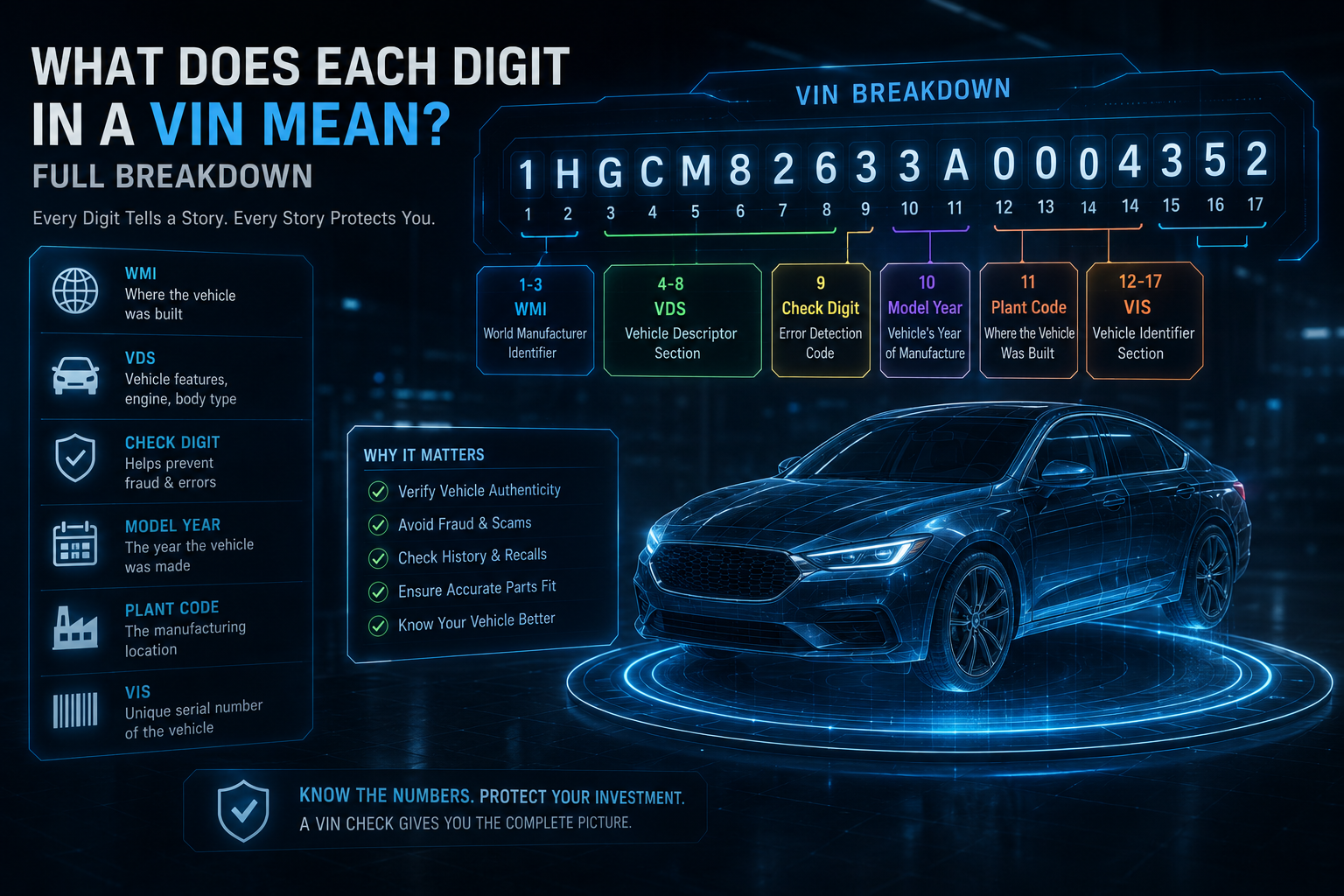
What does a VIN mean? A VIN (Vehicle Identification Number) is more than just a random string of characters
What Is a VIN Number?
The VIN is a unique code assigned to every vehicle. It includes letters and numbers that identify the manufacturer, model, engine type, and production details.
Table of Contents
The 17 characters in a VIN are divided into sections:
- Characters 1–3: Manufacturer and country of origin
- Characters 4–8: Vehicle attributes (model, engine, body type)
- Character 9: Check digit (used for validation)
- Character 10: Model year
- Character 11: Assembly plant
- Characters 12–17: Production sequence number
It is also important to note that VINs do not include the letters I, O, or Q. This is a global standard used to avoid confusion with the numbers 1 and 0. If you ever see these letters in a serial number while checking what a VIN means, it is a guaranteed sign that the VIN is counterfeit or incorrectly transcribed.
Why Understanding a VIN Matters
Knowing how to read a VIN helps you verify that a vehicle matches its listing. It can also help detect fraud or incorrect information.
Use a VIN Lookup Tool
If you don’t want to decode the VIN manually, you can use a VIN lookup tool to instantly view all details.
Check out VinForFree to run a free Vin check.
Breaking Down the Sections: What Does a VIN Mean
To truly understand what does a VIN mean, you have to look at the three distinct groups that make up the 17-character string.
The WMI (World Manufacturer Identifier) The first three digits tell you who built the car and where. For example, if the first digit is a 1, 4, or 5, the vehicle was assembled in the United States. A ‘J’ stands for Japan, and a ‘W’ stands for Germany.
The VDS (Vehicle Descriptor Section) Digits 4 through 9 are the “DNA” of the car. This section describes the model type, the body style, and the engine specs. Digit 9 is particularly interesting—it is a “Check Digit” used to verify that the VIN is authentic and not a fake generated by a scammer.
The VIS (Vehicle Identifier Section) The final 8 digits are unique to your specific vehicle. Digit 10 is the most popular one for buyers to check because it represents the Model Year. Digit 11 tells you the specific assembly plant where the car was put together, and the final 6 digits are the sequential production number.
How to Use This Information When Buying
When you are looking at a used car, what does a VIN mean for your wallet? It means protection. If the VIN on the dashboard doesn’t match the VIN on the door sticker or the title, you are looking at a “cloned” car or a vehicle that has been rebuilt from scraps. Always verify these digits match across all locations before handing over any cash.
Advanced Decoding: How Pros Use the 10th and 11th Digits
If you are still wondering what does a VIN mean for specific model verification, you need to look closely at the “Plant and Year” section. While most people can guess a car’s age by its body style, the 10th digit provides the legal model year.
For example, a “Y” in the 10th position signifies the year 2000, while letters like “A” through “H” represent 2010 through 2017. This is critical because some manufacturers release “New Generation” models mid-year. By checking what a VIN means at the 10th digit, you can ensure you aren’t paying a premium for a 2024 model when the car is actually a late-release 2023.
The 11th digit is equally important. This represents the Assembly Plant. If you are buying a vehicle known for having build-quality issues at a specific factory, the 11th digit will tell you exactly where that frame was welded and the engine was dropped in.
The Math Behind the 9th Digit: The “Check Digit”
One of the most fascinating answers to “what does a VIN mean” lies in the 9th character, known as the Check Digit. This digit is the result of a complex mathematical formula involving all the other characters in the VIN.
Each letter is assigned a numerical value, multiplied by a “weight” factor, and then divided by 11. The remainder of this math problem becomes the 9th digit. This exists specifically to stop criminals from inventing fake VINs. If a scammer changes even one number to hide a car’s history, the “Check Digit” math will fail, and a professional VIN lookup tool will immediately flag the serial number as invalid. This mathematical validation is a security standard monitored by the National Highway Traffic Safety Administration (NHTSA) to prevent vehicle identification fraud. You can also verify technical WMI codes through the Society of Automotive Engineers (SAE).
Summary Checklist for VIN Decoding
To ensure you have a complete grasp of what does a VIN mean during a live inspection, use this quick reference:
-
Characters 1-3: Does the country of origin match the “Made in…” sticker on the door jamb?
-
Character 10: Does the model year match the paperwork provided by the seller?
-
Character 17: Does the final serial number match the etched number on the engine block (if visible)?
By taking these extra steps, you transition from a casual buyer to an informed expert, ensuring that the vehicle you are putting your family in is exactly what the manufacturer intended it to be.
Final Thoughts
Understanding what each VIN digit means can give you valuable insight into a vehicle. Whether you decode it yourself or use a tool, it’s an important step in verifying any car.
If you want to skip the manual decoding to understand what does a VIN mean for your specific car, you can check a VIN for free using our automated lookup tool.

Leave a Reply