Decode a Ford Explorer VIN
Enter any 17-character VIN for free recalls, specs and safety data. Full vehicle history report: one-time $4.99, no subscription, no auto-renewal.
A Ford Explorer VIN Decoder lets you pull the model year, trim, engine, drive type, and assembly plant for any Explorer from its 17-character VIN, then cross-check that against NHTSA’s recall database before you buy.
For Ford VIN basics that apply across the whole lineup, see our full Ford VIN Decoder guide — this page goes deeper on the Explorer specifically with our own Ford Explorer VIN Decoder coverage: what its VIN characters mean, its real recall history, and problems owners actually report by generation.
How to Decode an Explorer VIN (Positions 4–8)
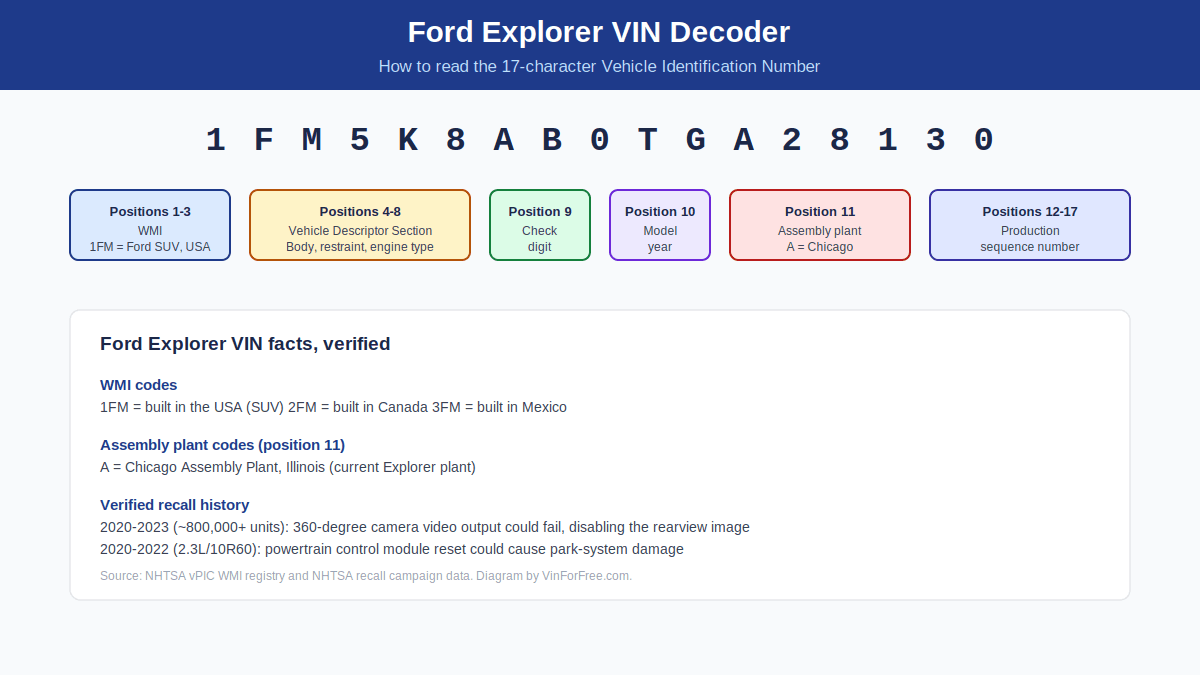
Every Explorer VIN starts with a WMI confirming it’s a Ford SUV and where it was built. Based on NHTSA’s official vPIC database:
- 1FM – Explorer built in the United States (Chicago Assembly Plant, Illinois)
- 2FM – Explorer built in Canada
Characters 4–8 make up the Vehicle Descriptor Section, and for the Explorer this is where trim, restraint system, body style, and engine data live:
- Position 4–6 – typically encode series/trim level and drive configuration (RWD-based platform vs. AWD)
- Position 7 – body style
- Position 8 – engine code (the current Explorer has shipped with the 2.3L EcoBoost turbo I4, 3.0L EcoBoost turbo V6 (ST and Platinum), and a 3.3L hybrid powertrain — the position-8 character narrows down which one)
Position 9 is the check digit, position 10 is the model year, and position 11 identifies the assembly plant. As with any Ford, confirm the exact trim and engine against the window sticker or build sheet, since the VIN narrows it down but doesn’t spell out every option package.
Example: A Real Ford Explorer VIN Decoder Result
Here’s an actual Explorer VIN run through NHTSA’s vPIC decoder:
VIN: 1FMSK8DH6PGA12345
| Make | Ford |
| Model | Explorer |
| Model Year | 2023 |
| Trim | XLT |
| Body Class | Sport Utility Vehicle (SUV) |
| Engine | 2.3L, 4-cylinder (EcoBoost turbo) |
| Drive Type | 4WD/4×4 |
| Fuel Type | Gasoline |
| Plant | Chicago, Illinois, USA |
You can run this same lookup — or your own Explorer’s VIN — through NHTSA’s public vPIC VIN Decoder to verify it yourself.
Ford Explorer Recalls You Should Check
Recall patterns differ meaningfully by generation. Before buying a used Explorer, always run the specific VIN through NHTSA’s recall lookup — recall status is VIN-specific, not just model-and-year-specific. Some of the most significant campaigns on record:
6th generation (2020–present, RWD-based platform):
- NHTSA #20V693000 / #23V199000 / #23V675000 / #25V166000 – Rear axle/driveshaft bolts can fracture, risking vehicle rollaway or sudden loss of drive power — one of the more persistent issues on this generation, spanning several repair campaigns
- NHTSA #21V735000 / #23V022000 / #23V342000 / #26V123000 – 360-degree camera video output failures (blank, frozen, distorted, or inverted image), recurring across multiple campaigns
- NHTSA #20V788000 – Right motor mount fasteners can loosen over time, risking axle disconnection and power loss
- NHTSA #21V154000 – Rear lower control arm bolts that weren’t properly heat-treated, risking breakage and loss of steering control
- NHTSA #24V598000 – Engine failure with an associated engine-compartment fire risk
- NHTSA #23V626000 – (Hybrid) manufacturing defect in high-voltage battery cells that can cause an internal short circuit
5th generation (2011–2019):
- NHTSA #15V464000 / #16V245000 / #19V435000 / #20V675000 – Rear suspension toe links can fracture (improperly welded, or fractured from stress/corrosion), risking sudden loss of steering control — recurring across multiple model years and repair campaigns
- NHTSA #17E048000 – Wheel hub bearings lacking a self-retention feature, risking wheel separation
- NHTSA #21V537000 – Road salt can corrode and seize the rear cross-axis ball joint, risking fracture and steering loss
This is not the complete list. Always check the full record for your exact VIN.
Common Ford Explorer Problems by Generation
Beyond official recalls, this Ford Explorer VIN Decoder page also covers issues widely reported by owners and independent mechanics (not all rose to the level of an NHTSA recall, so treat them as things to specifically inspect for, not confirmed defects on every SUV):
- 2020–2022 (6th gen, early production): Beyond the rear axle bolt and camera recalls above, early build-quality complaints (panel gaps, infotainment glitches, power liftgate faults) were common enough during this platform’s launch window that a pre-purchase inspection is worth the extra time.
- 2011–2017 (5th gen): Beyond the toe-link recalls, the 3.5L EcoBoost V6 on higher-mileage examples has documented coolant intrusion and turbocharger complaints reported by independent mechanics; the 3.5L naturally aspirated V6 is generally reported as more trouble-free.
- 3.0L EcoBoost (ST/Platinum, 2020+): Oil consumption and turbo-related complaints show up often enough in owner forums and mechanic write-ups to be worth a compression or oil-consumption check on a higher-mileage ST before buying.
Check a Specific Explorer’s Recall & Reliability History
For year-by-year recall counts, complaint trends, and a reliability breakdown, see our Ford Explorer reliability report. It pulls the same NHTSA data referenced above, organized by model year.
To check recalls, specs, and history on one specific Explorer rather than the model in general, run its VIN through our Ford Explorer popular VIN checks — no signup or credit card required. For accident history and title records on top of the free specs and recall data, our VIN Pro Plus report is a flat $4.99, one report, one price, no subscription.
Ford Explorer VIN Decoder: Frequently Asked Questions
Does the Explorer’s VIN tell me which engine it has?
Partially. Position 8 of the VIN is the engine code and narrows it down, but with the 2.3L EcoBoost, 3.0L EcoBoost, and hybrid powertrain all sharing similar body styles, it’s safest to confirm the exact engine against the window sticker, build sheet, or by checking under the hood.
Where is my Explorer built?
Explorers carrying a “1FM” WMI are built at Ford’s Chicago Assembly Plant in Illinois. The plant character (position 11) can help confirm this further.
Is the rear axle bolt recall a reason to avoid a 2020–2023 Explorer?
Not necessarily — it’s a free dealer repair, and Ford has issued multiple follow-up campaigns to fully resolve it. It is, however, a reason to confirm the specific VIN has had the repair completed before buying, since the underlying issue (rollaway or loss of drive power) is serious.
Is the Explorer decoded differently from the Lincoln Aviator?
Yes. The Aviator is Lincoln’s version of the same RWD-based platform but is registered under Lincoln’s own WMI codes, not Ford’s, even though both are built at the Chicago Assembly Plant.
Running this Ford Explorer VIN Decoder before you buy takes a couple of minutes and can save you from a costly surprise down the road.
Explore More
Looking for another Ford model? See our complete Ford VIN Decoder guide for the full lineup, or check out our Ford Explorer reliability report for year-by-year recall and complaint data.
Vehicle history report guides
- Free VIN check vs full vehicle history report
- How much does a vehicle history report cost?
- What a $4.99 vehicle history report includes
- CARFAX alternative: $4.99 vehicle history report
Related guides
