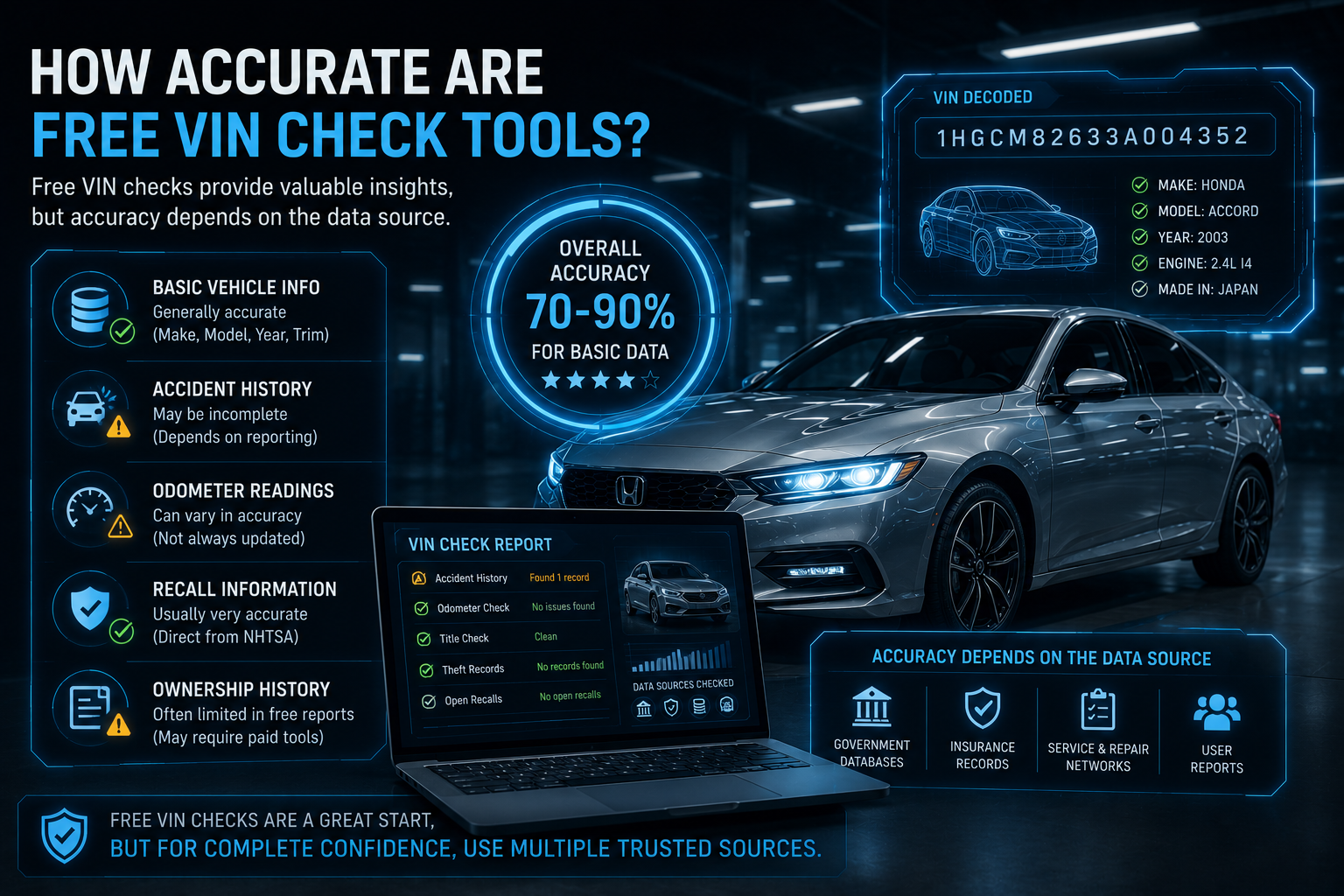
Free VIN check tools are a popular way to quickly look up vehicle information. But many buyers wonder how accurate these tools really are and whether they can be trusted when making a major financial decision.
What Free VIN Check Tools Provide
Most free VIN check tools pull data from public and official sources to give you a baseline of a vehicle’s history. This typically includes:
-
Vehicle Specifications: Year, make, model, engine type, and assembly plant.
-
Safety Recalls: Information on unrepaired safety issues from the manufacturer.
-
Basic Details: Transmission type and drivetrain.
-
Reported Issues: Major title brands like salvage or flood damage that have been recorded by the state.
You can run a free VIN check here to see these details instantly.
How Accurate Is the Data?
Free VIN check tools are generally highly accurate for “static” data. This includes information that never changes, such as the engine specs and factory trim levels. This data is verified against the NHTSA’s official databases, making it very reliable for verifying that a seller is being honest about what they are selling.
However, for “dynamic” data—like accident history or maintenance records—the accuracy depends on whether the event was reported to a public agency.
The Limitations of Free VIN Check Tools
While free VIN check tools are incredibly useful, they do have limitations compared to paid, comprehensive reports. For example:
-
Unreported Accidents: If an owner crashed their car and fixed it “off the books” at a private shop, no VIN tool will show that damage.
-
Private Maintenance: Basic oil changes and minor repairs performed at home won’t appear in these databases.
-
Recent Data Lags: It can take a few weeks for a local police report or a state title transfer to propagate through the various systems used by free VIN check tools.
Why Use a Free Tool First?
For most car buyers, starting with free VIN check tools is the smartest first move. It allows you to filter out cars with obvious red flags—like active recalls or incorrect engine descriptions—before you spend any money on a physical inspection. It’s a fast, zero-cost way to verify the “DNA” of a vehicle.
Summary: Are They Accurate Enough?
Yes, free VIN check tools are accurate for identifying the core identity of a car and major reported safety issues. While they shouldn’t be the only tool you use, they are an essential part of the modern car-buying process. Always combine your digital research with a physical test drive and a professional mechanic’s inspection.
How to Verify Information from Free VIN Check Tools
While free VIN check tools provide a wealth of information, savvy buyers should always perform a “double-check” on critical data points. For example, if a tool identifies a vehicle as having a 2.0L Turbo engine, verify this by looking at the emissions sticker under the hood during a physical inspection.
Furthermore, compare the odometer reading provided by the free VIN check tools against the physical dashboard. If the tool shows a higher mileage from a year ago than what is currently on the odometer, you have likely uncovered a “mileage rollback” scam. Using these tools as a starting point for your own physical investigation is the most effective way to ensure you are getting a fair deal.
Understanding the Sources of Free VIN Data
Have you ever wondered where free VIN check tools get their power? Most of the data is aggregated from the National Highway Traffic Safety Administration (NHTSA), which maintains the master list of all vehicles manufactured for sale in the United States. Other data points come from state DMVs, insurance total-loss records, and salvage auction houses. By pulling from multiple public streams, free VIN check tools can provide a comprehensive snapshot that was once only available to dealerships and insurance companies.
Final Verdict: Should You Rely Solely on Free Tools?
While we advocate for the use of free VIN check tools as a primary research method, they should be one part of a larger strategy. A digital report can tell you what happened on paper, but it can’t tell you how the car feels on the road today.
Use these tools to eliminate “lemons” early in the process so you don’t waste time and money on inspections for cars with major title brands or active safety recalls. Once a vehicle passes the digital test, proceed with a high-speed test drive and a professional mechanic’s review to complete your due diligence.
Common Myths About Free VIN Decoding
Many people believe that free VIN check tools are less reliable than paid ones simply because they don’t cost anything. In reality, both free and paid services often pull from the same foundational databases, such as the NHTSA VPIC system. The primary difference is usually the interface and the depth of private insurance data.
Another myth is that free VIN check tools can tell you the name of the previous owner. Due to privacy laws like the Driver’s Privacy Protection Act (DPPA), no legitimate tool—free or paid—will publicly disclose personal owner information. If a site claims to offer this for free, it is a significant red flag for a scam. Stick to reputable platforms like VinForFree to ensure your data and privacy remain protected while you research your next vehicle purchase.
While the accuracy of digital records is high, it is always best to combine your research with a physical inspection. If you are ready to begin your verification process, you can run a free VIN check here to instantly compare factory specifications against a seller’s listing for better accuracy.

Leave a Reply