Data Sources — VinForFree.com
Last Updated: June 21, 2026
Transparency about where our data comes from is core to our mission. This page explains every data source we use — for both our free VIN decoder and our paid VIN Pro Plus reports.
Free Report Data Sources
These sources power every free VIN report on VinForFree.com. All are government-backed or publicly available databases.
1. NHTSA VPIC API — Vehicle Specs & Recalls
Source: National Highway Traffic Safety Administration
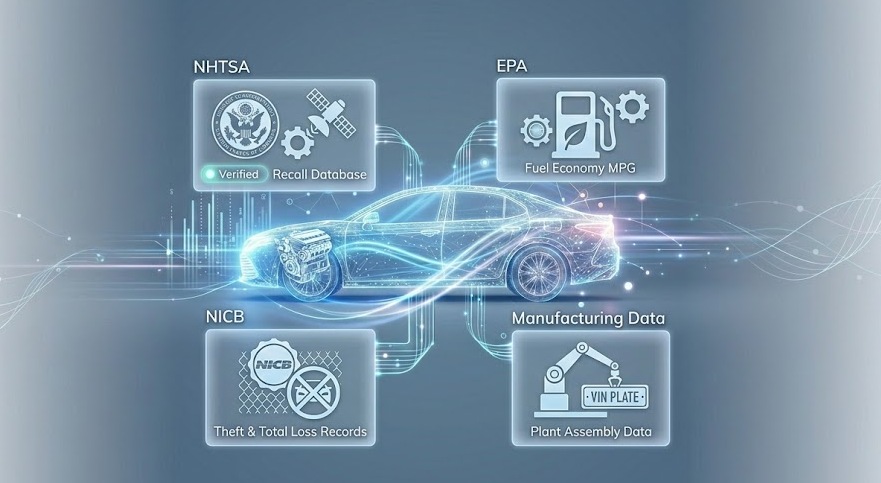
The NHTSA Vehicle Product Information Catalog (vPIC) API is the official government database used by manufacturers, law enforcement, and regulators to decode VINs. We use it to provide year, make, model, trim, engine, transmission, body style, plant of manufacture, and country of origin for every vehicle.
NHTSA also provides our safety recall data — the same database used by dealerships to check for open recalls. If a vehicle has an outstanding manufacturer recall, it will appear in our free report.
2. NHTSA Complaints Database — Consumer Complaints
Source: NHTSA Consumer Complaints
Real complaints submitted by vehicle owners to NHTSA about safety defects, mechanical failures, and performance issues. We aggregate complaint counts by make, model, and year so you can see recurring problems reported by actual owners before you buy.
3. NHTSA 5-Star Safety Ratings — Crash Test Data
Source: NHTSA 5-Star Safety Program
Government-administered crash test ratings covering frontal, side, and rollover performance. Where available, we display the full 5-star breakdown for the specific vehicle being decoded.
4. EPA FuelEconomy.gov — Fuel Economy & Emissions
Source: EPA FuelEconomy.gov
Official EPA fuel economy ratings including city, highway, and combined MPG, annual fuel cost estimates, CO2 emissions, and SmartWay certification status. For electric vehicles, we include EPA-rated range and energy consumption data.
5. CarQuery API — Extended Vehicle Specifications
Source: CarQuery
Extended vehicle specifications including engine displacement, horsepower, torque, fuel type, number of cylinders, valves, and drivetrain configurations. Used to fill gaps in NHTSA spec data, particularly for older or international models.
6. Technical Service Bulletins (TSBs)
Source: NHTSA TSB Database
Manufacturer-issued service and repair guidance for known mechanical issues. Unlike recalls, TSBs are not mandatory — but they are critical information for a mechanic reviewing a vehicle before purchase. We surface TSB counts and categories for each vehicle where available.
VIN Pro Plus Data Sources (Paid — $4.99)
These sources are only accessible through licensed data provider agreements. They power our paid VIN Pro Plus reports.
7. Licensed Vehicle History Data Provider
Type: Private — Licensed Third-Party Provider
VIN Pro Plus reports are powered by a licensed vehicle history data provider with access to:
- Private insurance company records — accident claims, collision damage, total loss declarations
- State title agency records — title status (clean, salvage, rebuilt, junk, flood), title brands
- Odometer disclosure records — mileage at each title transfer, rollback flags
- Ownership history — number of previous owners and ownership durations
- Flood and fire damage records — insurance-reported flood, fire, and hail damage events
This is the same underlying data network used by major vehicle history services. We access it through a licensed B2B API agreement.
8. NMVTIS — National Motor Vehicle Title Information System
Source: U.S. Department of Justice — NMVTIS
NMVTIS is a federal database established under 49 U.S.C. § 30502 that consolidates title, salvage, and theft data from state DMVs, insurance carriers, and salvage yards across the country. It is one of the most authoritative sources for title status and total loss history.
Required NMVTIS Disclosure: Not all states report to NMVTIS, and not all transactions are immediately entered. A clean NMVTIS record does not guarantee a clean vehicle history. Refer to vehiclehistory.gov for more information on NMVTIS coverage.
9. NICB — National Insurance Crime Bureau
Source: NICB
Theft and total loss records reported by participating insurance companies. Helps identify vehicles that were reported stolen, declared a total loss, or involved in insurance fraud.
What Each Report Type Includes
| Data Point | Free Report | VIN Pro Plus |
|---|---|---|
| Year, make, model, trim | ✅ | ✅ |
| Engine & transmission specs | ✅ | ✅ |
| Fuel economy (EPA) | ✅ | ✅ |
| NHTSA safety recalls | ✅ | ✅ |
| Consumer complaints | ✅ | ✅ |
| Crash test ratings | ✅ | ✅ |
| Technical service bulletins | ✅ | ✅ |
| VIN Quality Score (0–100) | ✅ | ✅ |
| VFF Score (300–850) | ✅ | ✅ |
| Market value estimate | ✅ | ✅ |
| Accident & collision history | ❌ | ✅ |
| Title status (salvage, flood, etc.) | ❌ | ✅ |
| Number of previous owners | ❌ | ✅ |
| Odometer records & rollback flags | ❌ | ✅ |
| Flood & fire damage history | ❌ | ✅ |
| NMVTIS title data | ❌ | ✅ |
Important Limitations
No vehicle history report — free or paid — is complete. Data gaps exist because:
- Not all accidents are reported. Minor collisions paid out of pocket are not reported to insurance companies and do not appear in any database.
- State reporting varies. Not all U.S. states report title events to NMVTIS or private insurance networks at the same speed or completeness.
- Older vehicles have fewer records. Electronic record-keeping is limited for vehicles manufactured before the mid-1990s.
- International vehicles. Vehicles originally manufactured or registered outside the U.S. may have limited or no U.S. history records.
A clean report is a good sign — not a guarantee. Always have any used vehicle inspected by a licensed mechanic before purchase.
Our Commitment
We will always tell you where your data comes from. We will never present data as more complete or certain than it is. We will always clearly separate free public data from paid private data.
Additional Resources
- Run a Free VIN Check
- VIN Pro Plus — Full History Report ($4.99)
- Sample VIN Report
- FAQ
- Disclaimer & Terms of Use
VinForFree.com — Transparent data, honest limitations.