Decode a Ford F-150 VIN
Enter any 17-character VIN for free recalls, specs and safety data. Full vehicle history report: one-time $4.99, no subscription, no auto-renewal.
A Ford F-150 VIN Decoder lets you pull the model year, cab/trim, engine, drive type, and assembly plant for any F-150 straight from its 17-character Vehicle Identification Number, then cross-check that against NHTSA recall data before you buy. For Ford VIN basics that apply across the whole lineup, see our full Ford VIN Decoder guide — this page goes deeper on the F-150 specifically: what its VIN characters mean, its real recall history, and problems owners actually report by generation.
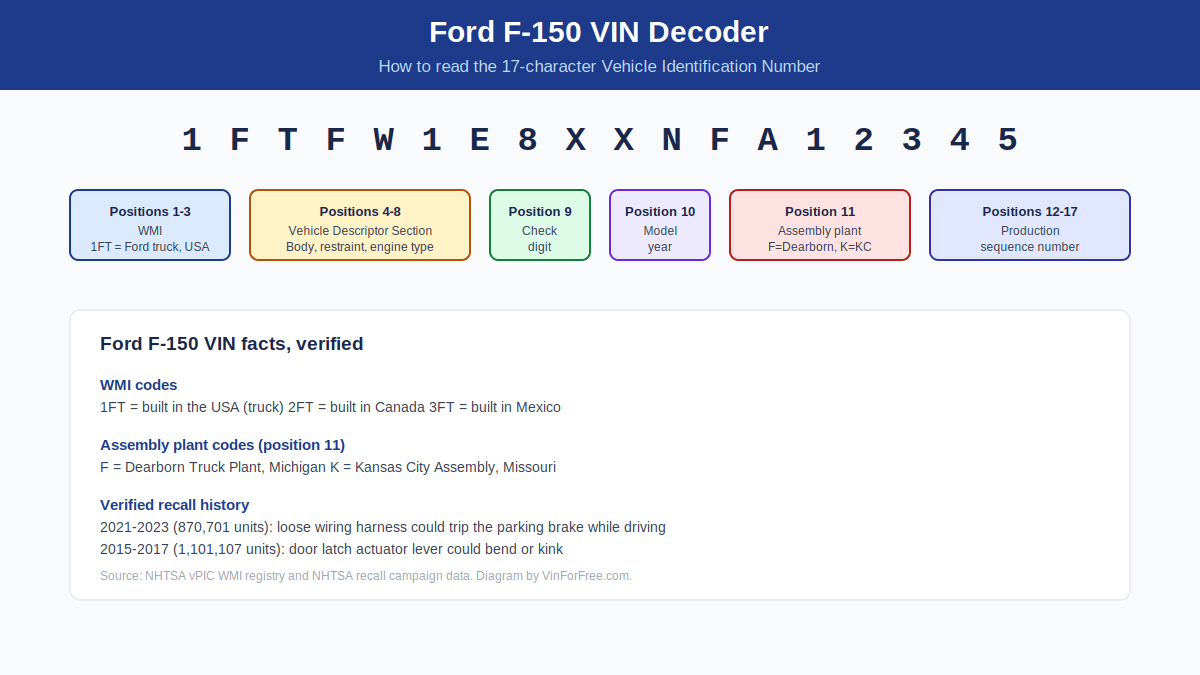
How This Ford F-150 VIN Decoder Reads Positions 4–8
Every F-150 VIN starts with a WMI (World Manufacturer Identifier) that confirms it’s a Ford truck and where it was built. Based on NHTSA’s official vPIC database:
- 1FT – F-150 built in the United States (most common, primarily Dearborn, Michigan and Kansas City, Missouri)
- 2FT – F-150 built in Canada
- 3FT – F-150 built in Mexico
Characters 4–8 make up the Vehicle Descriptor Section (VDS), and for the F-150 this is where cab style, engine, and trim-adjacent data live:
- Position 4–5 – typically encode the series/cab and chassis type (for example, SuperCrew vs. SuperCab vs. Regular Cab, and 4×2 vs. 4×4)
- Position 6 – restraint system type
- Position 7 – body style
- Position 8 – engine code (F-150s have shipped with the 3.3L V6, 2.7L EcoBoost V6, 5.0L V8, 3.5L EcoBoost V6, 3.5L PowerBoost hybrid V6, and, through 2020, the 3.0L Power Stroke diesel — the position-8 character narrows down which one)
Position 9 is the check digit, position 10 is the model year, and position 11 identifies the assembly plant. The remaining six digits (12–17) are the vehicle’s production sequence number. As with any Ford, the exact engine and trim package is safest to confirm against the window sticker or build sheet — the VIN narrows it down but doesn’t always spell out every option.
Example: A Real Ford F-150 VIN Decoder Result
Here’s an actual F-150 VIN run through NHTSA’s vPIC decoder, showing what comes back:
VIN: 1FTFW1E89PFA12345
| Make | Ford |
| Model | F-150 |
| Model Year | 2023 |
| Trim | SuperCrew |
| Body Class | Pickup |
| Engine | 3.5L, 6-cylinder (EcoBoost) |
| Drive Type | 4WD/4×4 |
| Fuel Type | Gasoline |
| Plant | Dearborn, Michigan, USA |
You can run this same lookup — or your own F-150’s VIN — through NHTSA’s public vPIC VIN Decoder to verify it yourself.
Ford F-150 Recalls You Should Check
Recall patterns differ meaningfully by generation. Before buying a used F-150, always run the specific VIN through NHTSA’s recall lookup — recall status is VIN-specific, not just model-and-year-specific. Some of the most significant campaigns on record:
13th generation (2021–present):
- NHTSA #21V986000 – Underbody heat/noise insulators can loosen and contact the aluminum driveshaft, risking fracture and loss of drive power
- NHTSA #22V142000 / #22V842000 / #23V163000 – Front windshield wiper motor or wiper arms can fail, reducing visibility (recurring issue across several campaigns)
- NHTSA #23V509000 – Wiring damage near the rear axle can cause the electric parking brake to activate unexpectedly while driving
- NHTSA #22V188000 / #25V169000 – A false low transmission-fluid-pressure code can cause the transmission to unexpectedly shift to neutral
- NHTSA #21V533000 – Electronic brake booster can leak brake fluid into its control unit, reducing braking performance
12th generation (2015–2020):
- NHTSA #17V652000 – Bent or kinked door actuation cables, or frozen latches, that can let doors open while driving
- NHTSA #18V894000 / #19V278000 / #20V098000 – Block heater cable corrosion/damage that raises fire risk on cold-climate trucks with the factory block heater
- NHTSA #15V279000 – Improperly riveted steering intermediate shaft, risking loss of steering control (2015 model year)
- NHTSA #20V332000 – Brake master cylinder can leak fluid into the brake booster, reducing braking performance
This is not the complete list — F-150s have accumulated dozens of individual campaigns across two decades of production. Always check the full record for your exact VIN.
Common Ford F-150 Problems by Generation
Beyond official recalls, this Ford F-150 VIN Decoder page also covers issues widely reported by owners and independent mechanics (not all of these rose to the level of an NHTSA recall, so treat them as things to inspect for, not confirmed defects on every truck):
- 2017–2020 (10-speed automatic): Harsh or hesitant shifting and torque-converter shudder are commonly reported with the 10R80 10-speed transmission introduced in this window, particularly at low speed.
- 2011–2016-era 3.5L EcoBoost carryover: Spark plug ejection/seizure on early EcoBoost V6 applications was a well-documented issue mechanics flag when inspecting higher-mileage EcoBoost trucks; later EcoBoost revisions addressed it.
- 2021+ (13th gen): The wiper motor and electric parking brake issues above are frequent enough in owner and mechanic reports that they’re worth testing specifically on a pre-purchase inspection, even on a truck with no open recall showing yet.
Check a Specific F-150’s Recall & Reliability History
This Ford F-150 VIN Decoder page covers general recall patterns by generation — for year-by-year recall counts, complaint trends, and a reliability breakdown, see our Ford F-150 reliability report. It pulls the same NHTSA data referenced above, organized by model year.
To check recalls, specs, and history on one specific truck rather than the model in general, run its VIN through our Ford F-150 popular VIN checks — no signup or credit card required. For accident history and title records on top of the free specs and recall data, our VIN Pro Plus report is a flat $4.99, one report, one price, no subscription.
Ford F-150 VIN Decoder: Frequently Asked Questions
Does the F-150’s VIN tell me which engine it has?
Partially. Position 8 of the VIN is the engine code and narrows it down, but with six gas engine options (and a diesel through 2020) sharing similar body styles, it’s safest to confirm the exact engine against the window sticker, build sheet, or by physically checking under the hood.
Where is my F-150 built?
Most F-150s carrying a “1FT” WMI are built at Ford’s Dearborn Truck Plant in Michigan or the Kansas City Assembly Plant in Missouri. The plant character (position 11) can help narrow this down further.
How many recalls does a typical F-150 have?
It varies significantly by model year and generation — some F-150 model years have accumulated over a dozen individual NHTSA campaigns. Always check the specific VIN rather than assuming based on model year alone, since not every truck from a given year is affected by every campaign.
Is the F-150’s VIN decoded differently from the Raptor or Lightning?
The Raptor is a performance trim of the standard gas F-150 and generally decodes the same way. The F-150 Lightning (electric) is a distinct model in NHTSA’s database with its own body/powertrain characters, so it won’t decode identically to a gas or hybrid F-150.
Explore More
That’s the full Ford F-150 VIN Decoder breakdown. Looking for another Ford model? See our complete Ford VIN Decoder guide for the full lineup, or check out our Ford F-150 reliability report for year-by-year recall and complaint data.
Vehicle history report guides
- Free VIN check vs full vehicle history report
- How much does a vehicle history report cost?
- What a $4.99 vehicle history report includes
- CARFAX alternative: $4.99 vehicle history report
Related guides
